
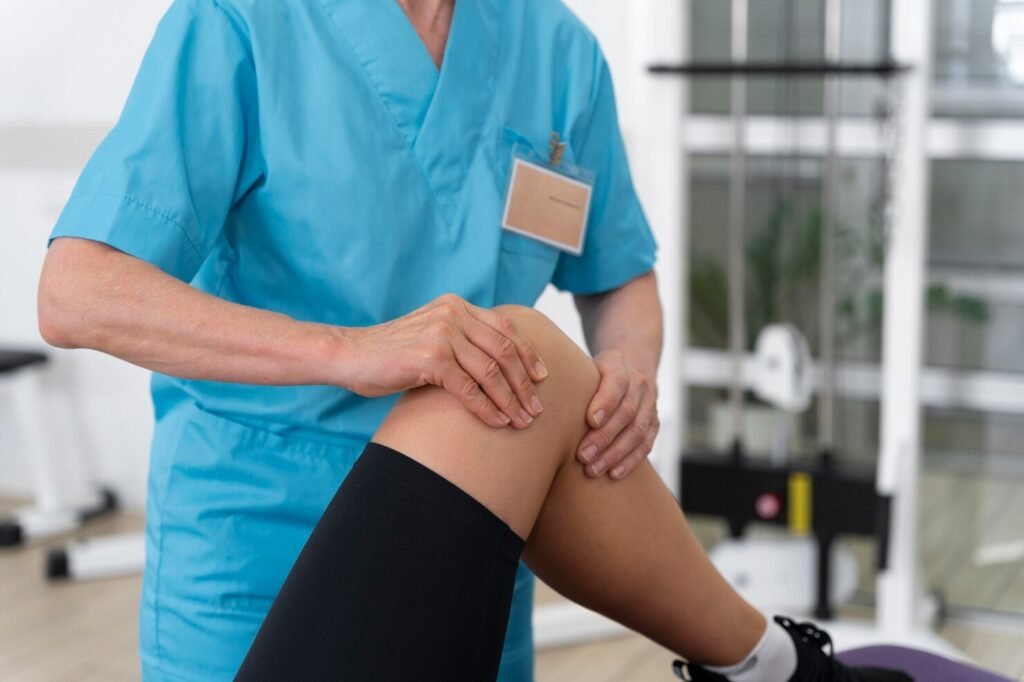
Knee pain can impact everything, or slowly even if you cannot walk and climb stairs to exercise and play sports. If you have cartilage damage, early arthritis, and/or ligament injuries or other knee problems, it is normal to be concerned about possibly needing a knee replacement in the future. But knee replacement isn’t the first or only treatment in every case.
Therefore, how to save yourself from knee replacement? In selected patients, a knee salvage technique may preserve the native knee joint, correct the underlying issue and possibly delay or avoid replacement of an arthritic knee.
Dr Nagraj Shetty is an arthroscopy, sports orthopaedics and complex knee preservation surgeon; with a special focus on Knee preserving surgeries. His methods encompass processes for cartilage damage, ligament injuries, meniscus issues and alignment problems that can affect long-term knee health.
What Is Knee Preservation?
Knee preservation are treatments that try to save as much of the original knee joint as possible and not replace all of it.
The appropriate treatment depends upon multiple issues such as/e.g. the age / level of activity of the patient, amount/location of cartilage damage, knee alignment and condition of ligaments in addition to general joint health. Consequently, a thorough evaluation is required prior to selecting an appropriate preservation method.
Prior to performing knee arthroplasty, knee preservation or knee sparing procedures such as arthroscopy, cartilage restoration, ligament reconstruction or osteotomy (surgical correction of mal-alignment leading to abnormal loading across the knee) would need to be attempted.
It’s not that we are only looking to treat knee pain for the short term. Its to detect the root cause of the problem and tackle it while keeping the patient’s natural joint intact.
Dr Nagraj Shetty has a special interest in complex knee preservation, particularly in procedures that allow the patient to remain active and retain the natural knee.
How Can Cartilage Therapy Help?
Cartilage is very important here because it allows the bones of the knee joint to slide smoothly over one another. Damage to cartilage can be painful, sometimes involving swelling, stiffness and difficulties with activity.
Cartilage therapy aims at the specific treatment of cartilage defects and, where appropriate, repairing damaged cartilage instead of availing joint replacement as a quick solution.
Various methods of cartilage restoration may be employed depending on the size and area of the cartilage defect.
OATS
OATS (Osteochondral Autograft Transfer System) – A surgical procedure in which healthy cartilage and some of the underlying bone is taken from a healthy site within the knee joint that is non-weight-bearing and transplanted to the area where the damage has occurred. It may be indicated for particular localised cartilage defects.
ACI
IntroductionAutologous chondrocyte implantation (ACI) is a well-established two-step surgical technique for the restoration of articular cartilage defects. Cartilage cells are harvested from the knee of a patient, multiplied in an incubator and then injected into the damaged section. It could be considered with specific patients for the larger cartilage defects.
Autocart
Autocart tissues around the defect are treated with minced cartilage tissue. The method involves transplanting healthy cartilage cells to aid repair in the affected area.
BMAC
Bone Marrow Aspirate Concentrate refers to the use of concentrated cells from within your own bone marrow. It can be considered in select cases with a cartilage defect or early degenerative change.
Any cartilage restoration procedure can be appropriate, depending on the specific knee condition. Consider a thorough assessment before selecting treatment options.
| Read More: Best 7 Exercises to Strengthen Knee After Injury or Surgery
Is Bracing Beneficial for Maintaining the Knee?
In particular kneecap issues, b Paradis says bracing could be useful within the Pay attention to optimizing knee fort help and manage strain through the program.
But, neither does a brace fix all forms of cartilage or structural damage. The roles differ depending on how the knee is aligned and stabilized.
For others it may be one approach to a broader non-operative treatment plan. For example, a ligament injury may be treated conservatively with rest and rehabilitation or through bracing depending on the nature and severity of an injury.
The key point is that a brace should not be chosen because the knee hurts. The root cause for the pain needs to be diagnosed before you can plan a proper treatment.
Does Knee Preservation Delay a Total Knee Replacement?
For carefully selected patients, we may be able to postpone or even prevent knee replacement through knee preservation methods.
Now this doesn’t mean that every patient with knee arthritis or cartilage damage is able to avoid replacement forever. The treatment decision also depends on the condition of the knee, how much damage there is to the joint, its alignment, activity requirements and other individual circumstances.
The benefit of assessing options for knee preservation at earlier time points is that certain issues may be corrected/fixed before the joint becomes advanced with degenerative changes.
A focal cartilage defect, for instance, may be a candidate for cartilage restoration. An alignment problem may demand a process such as high tibial osteotomy to redistribute strain through the knee. Reconstruction of ligament instability for stabilization of the joint and protection
In this regard, it is so important how to avoid knee replacement by treating the underlying problem.
Knee Preservation: When To Choose
If you have: knee preservation may be a topic for discussion
- Localised cartilage damage
- Early or moderate degenerative changes
- Knee pain affecting your activity
- Previous knee injuries
- Ligament instability
- Meniscus problems
- Abnormal knee alignment
- Not able to resume sports or exercise due to ongoing knee symptoms
This allows for an early assessment of the knee with respect to whether a preservation strategy is appropriate or not.
Dr Nagraj Shetty is an expert in complex knee preservation, cartilage restoration and has special interest in ligament reconstruction, meniscus procedures and osteotomy. Rather than proceeding towards routine replacement in all patients, his treatment philosophy is centered on preserving the natural knee where feasible.
Early Intervention Averting a Knee Replacement
There is no treatment or procedure that can stop someone from getting a knee replacement consistently. But well recognizing and treating knee disorders in the early stages can help to preserve the native joint.
We tell patients that knee pain, swelling and stiffness that persists despite more than six weeks of home care warrants an appropriate evaluation; if the knee is unstable or you have difficulty performing activities that were easy before (like walking up a hill or stairs), then it may be unwise to ignore your knee symptoms.
Arthroscopy, Sports Orthopaedics and Complex Knee Preservation by Dr Nagraj Shetty The treatment may consist of non-operative management, bracing, rehabilitation, cartilage therapy and/or arthroscopic or ligament reconstruction or other knee preservation procedure depending on the patient’s diagnosis.
The aim is simple: save the knee when it can be done safely, and keep patients out on the field for longer.
Frequently Asked Questions
How to avoid knee replacement?
It depends on the knee condition but to avoid knee replacement. In appropriately selected patients, early intervention with rehabilitation, bracing, chondral restoration procedures, ligament reconstruction or realignment and other knee preserving techniques may help delay or eliminate the need for arthroplasty.
What is knee preservation?
Knee preservation is an approach designed to maintain the patient’s knee. It can involve cartilage restoration, ligament reconstruction, meniscal procedures, osteotomy and arthroscopic surgery.
What is cartilage therapy?
Cartilage therapy includes treatments used to treat damaged cartilage. Options include OATS, ACI, Autocart and BMAC depending on the defect.
Does bracing protect the knee?
In some circumstances bracing may be used to provide support and to help dissipate stresses across the knee. But it would be useful in only specific conditions of the knee, and it should have been determined after a proper evaluation.
Long-Term Knee Preservation May Buy Time Before Knee Replacement
Yes, knee preservation procedures can postpone or even prevent the need for knee replacement in select patients But it depends on the degree of joint damage and general condition of the patient.
If you have ongoing knee pain or are considering a knee replacement, a joint-preserving evaluation may help give insight if you qualify for natural-joint-preserving options. Book an appointment with Dr. Nagraj Shetty for evaluation and treatment options of your knee condition.
| Read More: Why Early Intervention Matters for Knee Pain: What Most Patients Ignore